
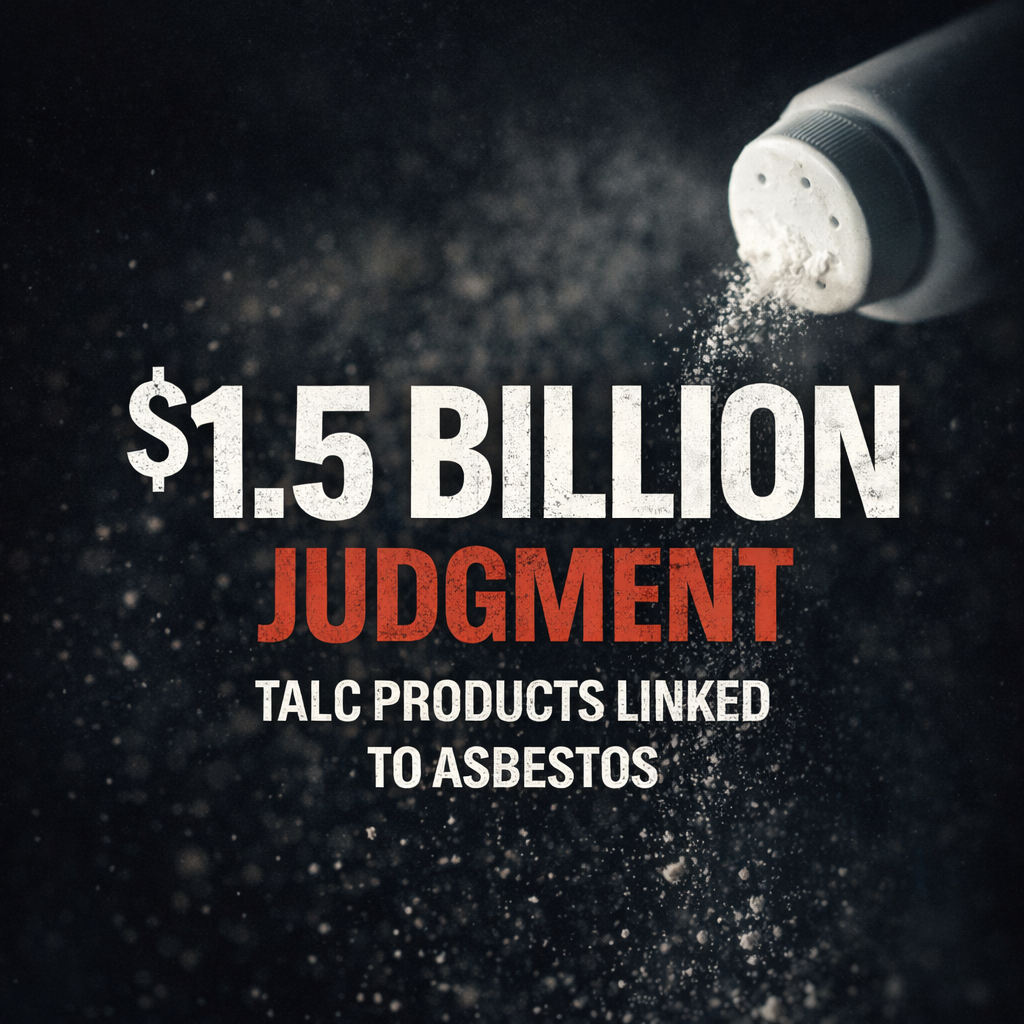
In late 2025, a Maryland jury returned a $1.5 billion verdict against Johnson & Johnson, finding that asbestos-contaminated talc products caused a woman to develop mesothelioma — a rare and aggressive cancer.
While talc-based products have been marketed for decades as safe for everyday use, this verdict underscores a growing body of evidence showing that consumer exposure to asbestos didn’t just happen at job sites. For many families, it happened at home.
What Happened in the Case?
The case involved a woman diagnosed with peritoneal mesothelioma, a cancer affecting the lining of the abdomen. Evidence presented at trial showed she used Johnson & Johnson talc-based baby powder regularly for decades.
Jurors concluded that asbestos contamination in those products was a substantial factor in her illness — and that consumers were not adequately warned about the risk.
The verdict included:
- Over $1.5 billion in punitive damages, meant to punish and deter corporate misconduct
- Nearly $60 million in compensatory damages, covering medical costs and other losses
According to reporting on the case, the jury found the conduct at issue went beyond simple carelessness and warranted significant punishment.
Why Talc and Asbestos Are Connected
Talc is a naturally occurring mineral. In the earth, it is often found near asbestos. When talc is mined, asbestos fibers can be disturbed and contaminate the final product if proper safeguards are not taken.
When talc products are shaken or applied, microscopic asbestos fibers can become airborne. Once inhaled or swallowed, those fibers can lodge in the body and remain there for decades.
Like other asbestos-related diseases, mesothelioma typically develops 20 to 50 years after exposure, meaning many people don’t connect a diagnosis today with a product they used long ago.
A Pattern, Not an Isolated Verdict
This was not the first major talc verdict — and it likely won’t be the last.
Across the country, juries have increasingly sided with mesothelioma patients after hearing internal company documents, historical testing data, and expert testimony about asbestos contamination in talc products. Several recent verdicts have reached into the hundreds of millions of dollars.
Together, these cases send a clear message: asbestos exposure is not limited to industrial settings, and companies can still be held accountable for consumer products that caused harm.
Does Johnson & Johnson Still Use Talc?
Johnson & Johnson stopped selling talc-based baby powder in the United States and Canada in 2020. The company later phased out talc-based formulas worldwide, transitioning to cornstarch-based alternatives.
However, discontinuing a product does not change what happened in the past — or the fact that asbestos-related illnesses may continue to emerge for years to come due to long latency periods.
Why This Matters for Families Today
Many people diagnosed with mesothelioma or asbestos-related lung cancer never worked in shipyards, refineries, or construction. Some were exposed through household products they trusted.
Verdicts like this one highlight the importance of understanding all possible sources of asbestos exposure, including consumer goods.
For families facing a diagnosis, learning where exposure may have occurred can be an important step toward answers and accountability.
If you or a loved one has been diagnosed with mesothelioma or another asbestos-related disease in Louisiana, Call us today at (504) 299-1214 for a free consultation, or fill out our online form to get started.